Avian immunosuppressive diseases: How does immunosuppression affect the poultry industry? – Dr. Miquel Nofrarias’ approach
26 July 2021


Avian immunosuppressive diseases are often undetected and underestimated, but they have a significant direct and indirect economic impact by affecting flock performance, clinical disease, vaccine failures and increased use of antibiotics. Mishandling, stress, mycotoxins, and several pathogens, such as Infectious Bursal Disease virus, are the main causes of immunosuppression.
During the World Poultry Virtual Congress by HIPRA, Dr. Miquel Nofrarias explained the main causes and the impact of avian immunosuppressive disease on the poultry industry (see the recorded webinar below).

The role of the immune system is to fight against external agents and provide effective protection against infective microorganisms. There are two lines of defence, innate (or non-specific) immunity and adaptive (or specific) immunity.
Specific organs and cells are involved in the birds’ immune system, which are:
It is a temporary or permanent state of depression of the immune system, meaning that there is a suboptimal immune response (innate, cellular or humoral immunity).
Immunosuppression is not a disease and it has no clinical signs, it is an expression or a consequence of something damaging or impairing the immune system.
There is no specific indicator that confirms it, but there are several factors that could point towards possible immunosuppression:
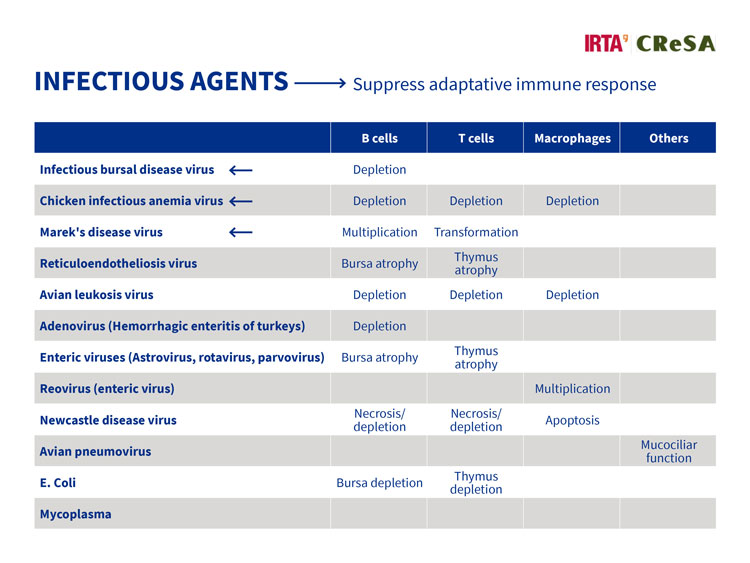
Immunosuppressive viral diseases have an important economic impact due to direct but also to indirect losses.
Direct losses are related to specific mortality, which will depend on the virulence, age and breed of the birds and the presence or absence of passive immunity. In addition, immunosuppression has a high impact on flock performance, with impaired growth and condemnation of carcasses.
On the other hand, immunosuppression leads to secondary infections that will increase the use of antibiotics to control them, which is a major concern for human health.
Furthermore, the efficacy of vaccinations is reduced, causing indirect economic loss and increasing the risk of infection in unprotected animals.
Studies conducted by Mc Ilroy et al. (1989) documented the economic impact of broiler flocks with Infectious Bursal Disease subclinical infection compared to flocks without lesions, showing a 14% decrease in financial return, an 11% reduction in net income per 1000 birds and +0.8% increase in flock mortality.
In addition, McNulty et al. (1991) studied the impact of CAV seropositive broiler flocks at slaughter compared to CAV seronegative flocks, showing a 13% smaller net income per 1000 birds, a 2% worse feed conversion ratio and a 2.4% lower average weight.
References: